
Inflation has been a top concern for American families since the COVID pandemic. The cost of living increased by an estimated 25% from January 2020 through December 2025. That is more than double the rate of increase experienced for the five years prior (2015 – 2019). While the inflation rate has moderated in recent years, prices are still going up. In fact, prices are still growing at a rate that is substantially higher than the target set by the Federal Reserve, which is the institution charged with maintaining price stability. Many investors and market prognosticators have taken solace in the stated commitment to fight inflation from the new chairman of the Federal Reserve, Kevin Warsh. During his Senate confirmation hearing in April, Fed Chair Warsh spoke eloquently about one half of the Fed’s dual mandate when he stated:
“First, Congress tasked the Fed with the mission to ensure price stability, without excuse or equivocation, argument, or anguish. Inflation is a choice, and the Fed must take responsibility for it.”
Tough talk from Warsh has been backed up by several other Fed Governors and regional bank presidents who sit on the FOMC, which is the committee that meets every six weeks to decide how to impact interest rates. In fact, while the FOMC has held rates unchanged during the first five meetings of 2026, three of the twelve voting members dissented from the majority decision during the most recent meeting in July and voted to raise rates. A few other voting members, including Chairman Warsh, voted to keep rates unchanged in July, but have continually expressed a willingness to hike rates if inflation does not come down. A prime example came from Fed Governor, Michael Barr, who on September 1, 2026, stated that if inflation isn’t moderating sufficiently, “I think we should act decisively to raise rates.”
Fed members have been talking and the market is listening. Below is a chart of the implied rates for the Fed Fund futures. This chart essentially shows the market’s prediction for what the Fed will do.
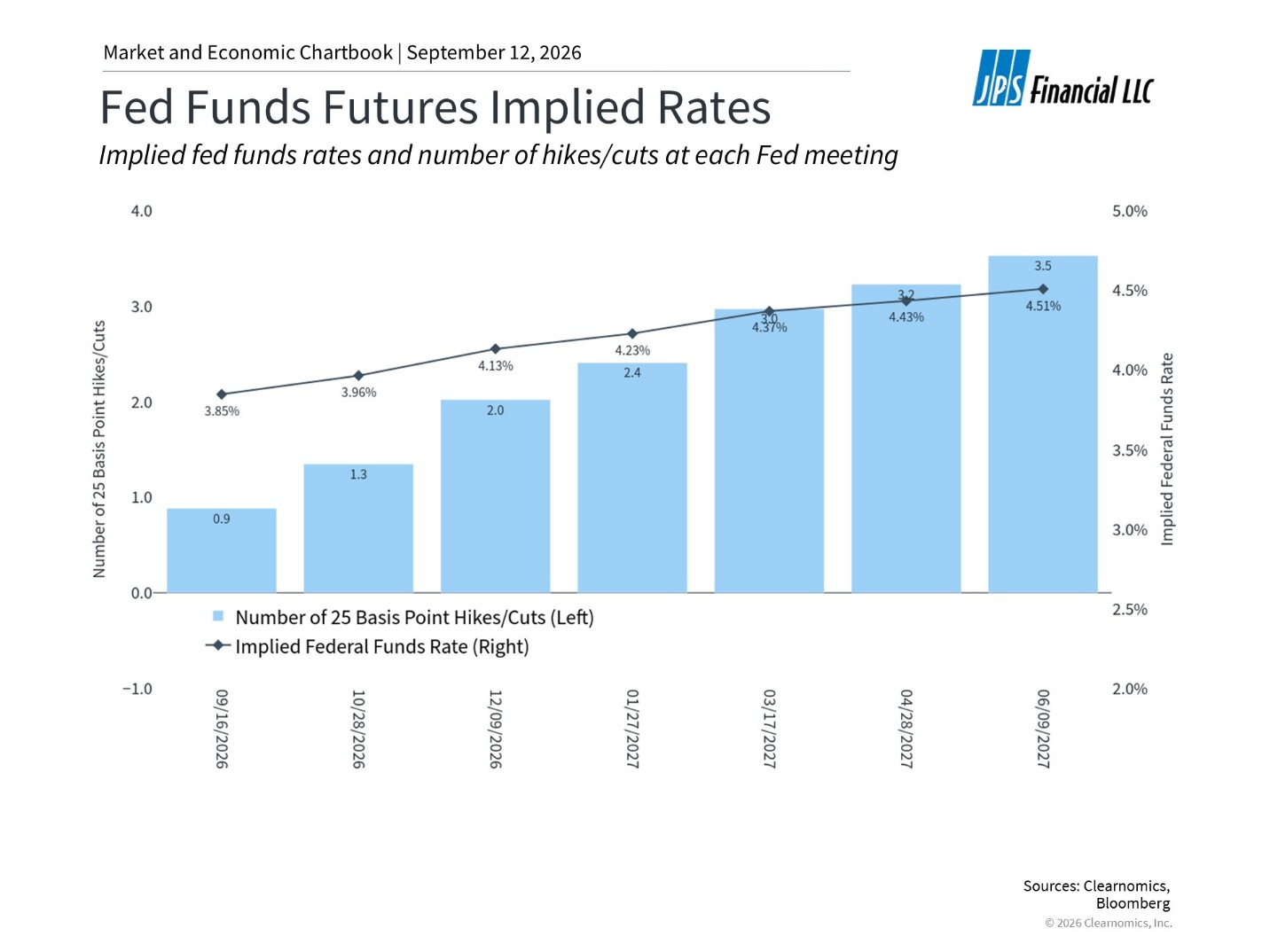
The Federal Reserve typically adjusts interest rates in quarter percentage point increments. The dates listed along the X-axis are the dates of future FOMC meetings. As you can see, there is a meeting coming up on 9/16/26. The height of the bar shows how many ¼ point hikes the market expects by each date listed. The 0.9 shown for 9/16 means that the market currently believes that it is all but certain that the Fed will raise rates on Wednesday. Looking out further to June of 2027, the market currently expects the Fed to raise rates 3.5x for a total increase of 0.875%. That would take the effective rate up to 4.51% from where it is today at 3.63%.
Before you fall asleep or stop reading, allow us to attempt to convince you of the important implications of these potential rate hikes. At the highest level, interest rate policy from the Federal Reserve impacts the rates that consumers pay on mortgages, car loans, business loans and just about every other borrowing rate in the economy. Fed Policy 101 says that if inflation is running too high (the economy is too hot), the Fed should raise rates to cool things off. Higher rates make it more expensive to borrow, and therefore, consumers and businesses will borrow less and slow the pace of economic expansion. One implication that is often glossed over by the media is the fact that higher interest rates don’t just make it more expensive for private citizens and businesses, it also makes it more expensive for the Federal Government. And for that reason, we don’t buy the tough talk from Warsh and company on fighting inflation and raising rates. It is not that they’re bad economists, or that they don’t want to do the right thing. Rather, we don’t think they truly have a choice.
Exhibit A as to why we feel the way we do is the chart below.
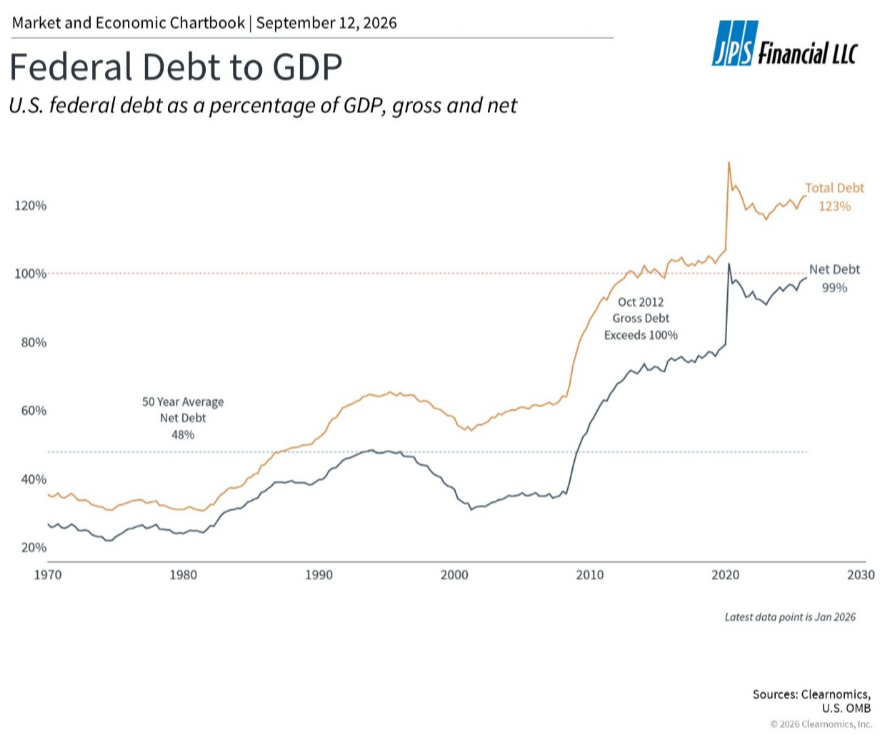
This chart shows the total debt owed by the US Government relative to the size of the economy. You’ll notice two lines; one for gross debt and one for net debt. The net debt line is the one that most government and CBO (congressional budget office) projections use. It ignores the money that the government owes to itself. While borrowing money from yourself is a privilege that only the issuer of the world’s reserve currency can enjoy, we’ll focus on the net debt line for now and try not to think about the potential issues that the government’s accounting gimmicks could cause down the road.
At first glance we can see the Net Debt is currently more than double the 50-year average at 99% of GDP. You’ll also notice that we are quickly working back up to the all-time high that was reached in the middle of the COVID response when many trillions of dollars were created out of thin air to pay for the various programs that were implemented. This is not a good position to be in, and as depicted in the chart, the US government’s financial position has deteriorated significantly over the last 20 years. Visually, it is clearly moving in the wrong direction.
To help put some concrete numbers to the obvious visual deterioration of the US government’s financial position, we can look to the congressional budget office’s report titled “Budget and Economic Outlook for 2026 to 2036,” published in February of this year. Inside the 173-page report, the CBO identifies net interest expense as the third largest line item in the federal budget, behind only Social Security and Medicare/Medicaid. The government will pay roughly $1 trillion in interest costs in 2026. Net interest cost is projected by the CBO to grow 7.5% per year to over $2.1 trillion by 2036. At that level, net interest outlays will nearly equal all federal discretionary spending.
While the CBO paints a dismal picture, one may downplay the meaning of a 10-year projection when we can hardly forecast economic and geopolitical events over the next 30 days. We would agree with that broadly. However, we do feel there is value in understanding what appears to be a dire circumstance today and to think about how much worse the situation could get with small adjustments to baseline assumptions. In forecasting net interest outlays 10 years out, the CBO is assuming that the average interest rate on all federal debt will rise as bonds mature and get refinanced. Remember, the government never actually pays off any of its debt. Rather it issues a new bond to pay off the maturing bond and borrows an additional $2 trillion each year that gets added to the total.
This is where the rubber hits the road. The CBO is projecting the federal funds rate to FALL to 3.4% by 2027 and stay there all the way through 2036. Remember, based on the chart above, the market expects the Fed Funds rate to rise to 4.5% by next summer based on the Fed’s recent rhetoric. The 10-year treasury bond is a more meaningful real-time gauge for market participants and the economy. The CBO’s report assumes that the 10-year will yield 4.3% from 2027-2030 and then tick up slightly to 4.4% from 2031-2036. The CBO report was published in February. Bond traders must have neglected to read the report as the market has taken the 10-year treasury all the way to 5% as of the morning of Monday, September 14th. A 5% 10-year treasury bond is nowhere to be found in the 175 pages of the report and would dramatically worsen an already difficult budget projection.
In summary, the Federal Reserve, led by new Chaiman Kevin Warsh, has repeatedly told us in recent months that the current rate of inflation is unacceptable to the American people and they intend to fight it by raising rates. Given the proximity of the next meeting this Wednesday, September 16th, it is likely that they will follow through with a rate hike of 0.25%. However, if they continue to raise rates as anticipated, the US fiscal deficit will grow exponentially larger, putting additional strain on an already stretched budget. Higher rates over the medium to long term would likely result in a severe recession and large stock market decline. We don’t believe the members of the FOMC have the stomach to see that through. Like Chair Warsh said during his Senate confirmation hearing, “Inflation is a choice, and the Fed must take responsibility for it.” Unfortunately for Mr. Warsh, the other choice is economic upheaval and asset price declines. When push comes to shove, we have a strong conviction about which choice the Fed would rather be responsible for.
JPS Financial, LLC is registered as an investment adviser with the SEC and only conducts business in states where it is properly notice filed or is excluded from registration requirements. Registration is not an endorsement of the firm by securities regulators and does not mean the adviser has achieved a specific level of skill or ability.
Charts do not represent the performance of the firm or any of its advisory clients and are derived from sources deemed to be reliable. All information is believed to be current and should not be viewed as investment, tax or legal advice. All expressions of opinion reflect the judgment of the authors on the date of publication and may change in response to market conditions. You should consult with a professional advisor before implementing any strategies discussed. All investments and investment strategies have the potential for profit or loss.
Copyright © 2026 JPS Financial, LLC